
Density Gradient Centrifugation Workflow: Preparation, Centrifugation and Fraction Recovery
Published: outubro 22, 2026
Key Takeaways
- Density gradient centrifugation involves gradient selection, preparation, sample loading, centrifugation, band identification, and fraction recovery.
- Gradient media should match the sample: sucrose supports general fractionation, while iodixanol suits AAVs, viral vectors, and extracellular vesicles.
- Rotor type, RCF, temperature, run time, and acceleration settings directly influence separation resolution, yield, and reproducibility.
- Automated preparation with the OptiMATE Gradient Maker standardizes gradient preparation, dispensing, tube sealing, and balancing while reducing manual variability.
- The OptiXTRACT Sample Recovery Aid supports controlled fraction recovery through guided needle positioning and improved visualization of closely spaced bands.
Density Gradient Centrifugation Workflow
Explore the main stages of density gradient centrifugation and discover the workflow considerations, best practices, and supporting instruments associated with each step.
Select the Gradient Material
Prepare the Density Gradient
Perform Centrifugation
Visualize and Identify Fractions
Fraction recovery
Select the Gradient Material
Choose a density gradient medium that matches the sample type, target particles, and separation objective. Common choices include sucrose for protein complexes and organelles, iodixanol for AAVs and extracellular vesicles, and cesium chloride for high-resolution nucleic acid and viral particle separations.

Reproducibility in density gradient workflows relies on consistent gradient preparation, centrifugation conditions, and fraction recovery. Tools such as the OptiMATE Gradient Maker help reduce variability, improve consistency, and cut linear gradient preparation time by up to 75%, while the OptiXTRACT Sample Recovery Aid supports accurate fraction collection and safer recovery.
Reducing Variability in Density Gradient Preparation
Achieving consistent density gradient results often depends on what happens before and after the centrifugation run. Gradient preparation, sample loading, tube sealing, and fraction recovery can all introduce variability that affects purity, recovery, and reproducibility.
Common Sources of Variability in Density Gradient Workflows
Even when using the same protocol, several factors can contribute to inconsistent results:
-
Gradient Preparation
Preparing gradients manually requires accurate formulation and careful layering of the gradient material. Small errors in concentration, layer placement, or mixing between layers can influence band formation and separation resolution.
-
Sample Loading
Introducing the sample too quickly or disrupting the gradient during loading may reduce resolution before centrifugation even begins. Proper technique helps preserve gradient integrity and improve band definition.
-
Fraction Recovery
The final recovery step can result in disturbing the gradient, collecting inconsistent volumes, or inadvertently mixing adjacent fractions, which can reduce yield and purity.
-
Operator Experience
Manual density gradient workflows can require significant training to perform consistently. Variability often increases when multiple operators prepare gradients or recover fractions using different techniques.
Manual vs. Automated Gradient Preparation: Trade-offs in Real Workflows
| Consideration | Manual Preparation | Automated Preparation |
|---|---|---|
| Workflow Flexibility | High | High |
| Hands-on Time | High | Low |
| Operator-to-Operator Variability |
Higher
|
Significantly reduced |
| Gradient Consistency | Dependent on technique | Standardized |
| Training Requirements | More extensive | Reduced |
| Throughput | Limited by operator capacity | More scalable |
| Reproducibility | Depends on user training and user-to-user variations | High |
Gradient Makers: Improving Reproducibility and Accuracy
Because gradient preparation is one of the most critical steps in density gradient centrifugation, many laboratories focus on standardizing this portion of the workflow. Automated gradient preparation systems can help:
- Improve consistency between gradients
- Reduce manual handling steps
- Minimize formulation and dispensing errors
- Simplify routine protocol execution
- Reduce training requirements for new users
The OptiMATE Gradient Maker is designed to automate key pre-centrifugation steps, including gradient preparation, dispensing, tube sealing, and removing the need for balancing your tubes. By reducing manual intervention during these workflow stages, laboratories may improve reproducibility while reducing hands-on time and workflow complexity. The system supports density gradient workflows commonly used for viral vectors, AAVs, proteins, extracellular vesicles, and other high-resolution separations.
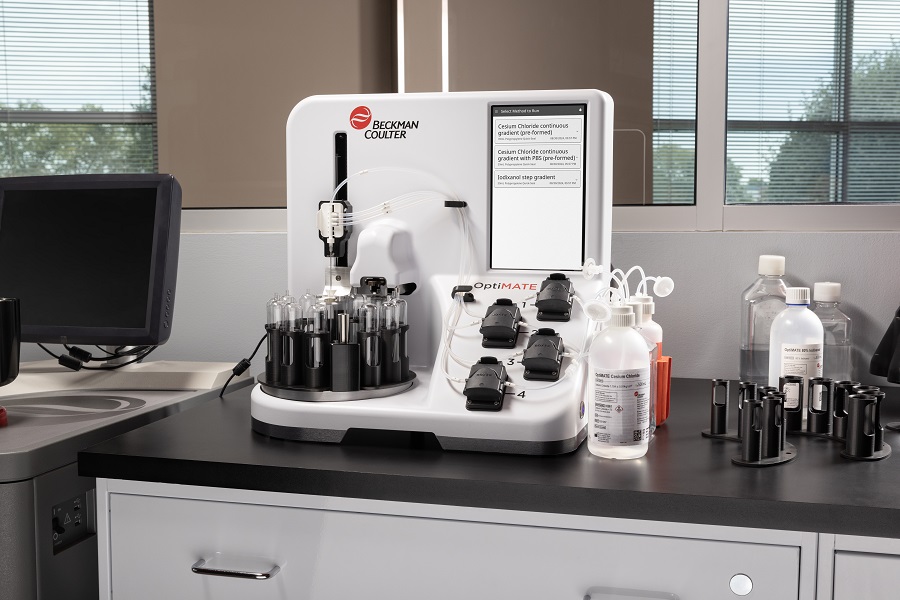
Figure 1. The OptiMATE Gradient Maker benchtop shown here is designed to reduce manual handling, improve consistency between runs, and support reproducible density gradient centrifugation workflows.
Visualizing Density Gradient Centrifugation
One of the most powerful aspects of density gradient centrifugation is that the separation can often be observed directly within the centrifuge tube. Following centrifugation, particles migrate to distinct positions within the gradient, forming visible bands or zones that represent populations with similar sedimentation properties or densities. Understanding what these bands represent can help researchers evaluate separation quality, identify fractions of interest, and troubleshoot workflow issues before downstream analysis begins.
How to Interpret a Density Gradient Diagram
During centrifugation, particles move through the gradient until they reach their separation endpoint. In rate zonal centrifugation, particles separate based on differences in sedimentation rate, resulting in distinct bands distributed throughout the gradient. In isopycnic centrifugation, particles migrate until they reach a location where their density matches that of the surrounding gradient medium, producing stable density-dependent bands.
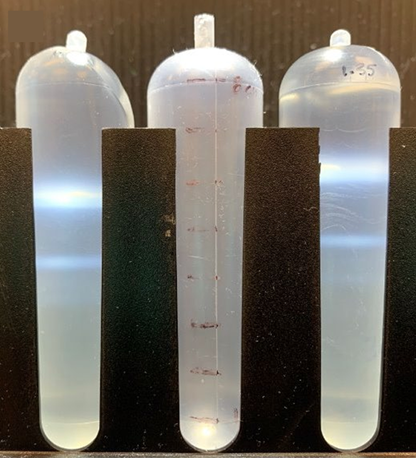
Figure 2: Empty and full AAV separation after centrifugation in a continuous CsCl gradient. The different AAV capsids migrate through the density gradient during centrifugation and separate into distinct bands according to their buoyant density. Researchers can then recover individual fractions for downstream analysis.
Common Separation Patterns and What They May Indicate
| Observation | Potential Interpretation |
|---|---|
| Sharp, distinct bands | Good separation and gradient integrity |
| Broad or diffuse bands | Sample overload, gradient instability, or diffusion |
| Overlapping bands | Insufficient resolution or inappropriate gradient selection |
| Bands appearing lower than expected | Excessive density or longer-than-optimal centrifugation |
| Bands appearing higher than expected | Gradient density too low or incomplete separation |
| No visible bands | Low sample concentration or incompatible visualization method |
Improving Fraction Recovery and Band Collection
A high-quality separation has limited value if the target fraction cannot be recovered consistently. Narrow bands, closely spaced fractions, and poor visibility can make manual recovery challenging, particularly for applications such as AAV purification or protein fractionation.
Common challenges include:
- Disturbing adjacent bands
- Recovering inconsistent volumes
- Limited visibility of separation interfaces
- Sample loss during manual extraction
The OptiXTRACT Sample Recovery Aid is designed to support controlled fraction recovery following density gradient centrifugation. Guided needle positioning and improved visualization can help researchers recover fractions more consistently while reducing disturbance of the gradient. This can be particularly beneficial when isolating closely spaced bands or recovering multiple fractions from a single tube.

Figure 3. The OptiXTRACT Sample Recovery Aid supports fraction recovery following density gradient centrifugation. Guided needle positioning and enhanced visualization help researchers collect target bands more accurately while minimizing disturbance of adjacent fractions.
Related Resources
FAQ about Density Gradient Centrifugation Workflows
What is the density gradient centrifugation procedure?
A typical density gradient centrifugation procedure involves preparing a gradient medium (e.g., sucrose or iodixanol), carefully layering the sample, centrifuging under controlled conditions, and collecting separated fractions.
The most critical step is gradient preparation, as small inconsistencies can significantly affect separation quality.
What determines separation during centrifugation?
Separation during centrifugation is determined by factors such as particle size, shape, density, centrifugation speed, and the properties of the gradient medium.
Optimizing these parameters is critical, as small changes can influence both resolution and yield.
What causes poor density gradient separation?
Common causes include inaccurate gradient preparation, uneven layers, air bubbles, inappropriate tubes or rotors, disruptive sample loading, inconsistent centrifugation parameters, and aggressive fraction recovery. Rate zonal separations may also fail if they run too long and the particles pellet.
How does gradient preparation affect separation quality?
Gradient preparation establishes the density environment through which particles move. Errors in concentration, layer placement, dispensing, or handling can change particle migration and reduce band definition. Consistent preparation is therefore essential for reproducible separation and fraction recovery.

